Not sure what you want from your career?
Try a simple career exercise to help you work out what's next
Sometimes the hardest career question isn't "What job should I do next?"
It's: "What do I actually want?"
You might know that something isn't quite right. Maybe you're bored. Maybe you've outgrown your role. Maybe you're exhausted. Maybe you're wondering whether it's time for a complete career change.
Or perhaps nothing is wrong, but you have a growing feeling that you want something more.
And that's where things can get complicated.
When we start thinking about our careers, we often jump straight to solutions:
Should I apply for another job?
Should I retrain?
Should I ask for a promotion?
Should I start a business?
Should I relocate?
But before answering "What should I do?", it can be much more useful to ask: what do I want to keep, what do I want to change, and what would I dream about if I stopped putting limits on myself?
That’s where the Keep, Change, Dream Big exercise comes in: a piece of paper, three columns and a pen are all you need.
1. KEEP: What is already working?
This is the column we often overlook.
When you're frustrated with your career, it's easy to focus on everything that's wrong. But what if you stopped and asked: what do I like about my working life?
Think about:
The parts of your role you enjoy
Skills you love using
People you enjoy working with
Your working environment
Flexibility
Responsibility
The sector you work in
Your income
The things that give you energy
You might discover that you don't want to throw everything away.
Perhaps you love your profession but hate the management structure. Perhaps you enjoy your expertise but want more autonomy. Perhaps you like your colleagues but have outgrown your role.
That's important information. A career change doesn't always mean starting from scratch. Sometimes it means protecting what already works while changing what doesn't.
2. CHANGE: What isn't working any more?
Now be honest. What would you change if you could?
This could be something significant:
Your role
Your manager
Your industry
Your working hours
Your level of responsibility
Your salary
Your location (that two-hour commute each way, for example)
Or something much more subtle:
Feeling undervalued
Lack of challenge
Poor work-life balance
No opportunity to develop
Constant uncertainty
A lack of confidence
Feeling that you've become stuck
Don't try to solve these problems straight away. Just identify them.
Because there is a difference between knowing "I'm unhappy" and being able to say "I'm unhappy because I haven't developed a new skill in three years and I no longer see a pathway forward."
The second gives you something you can work with.
3. DREAM BIG: What would you do without the "but"?
This is my favourite column, and it's also the one where we're most likely to hold ourselves back.
I'd love to... but I'm too old.
I'd love to... but I don't have the experience.
I'd love to... but I can't afford it.
I'd love to... but I've already spent 20 years doing something else.
I'd love to... but what would people think?
I'd love to... but I need to put food on the table.
Forget the "but" for a moment.
If you could design your working life without immediately worrying about whether it was possible, what would it look like? Would you:
Start something of your own?
Work in a completely different industry?
Work while travelling?
Lead a team?
Work fewer hours?
Use skills you've never had the opportunity to use?
Return to something you loved earlier in your career?
Finally pursue something you've been putting off?
You don't have to make the dream happen tomorrow. The point is to give yourself permission to identify it. Because you can't build a strategy around a destination you haven't allowed yourself to imagine.
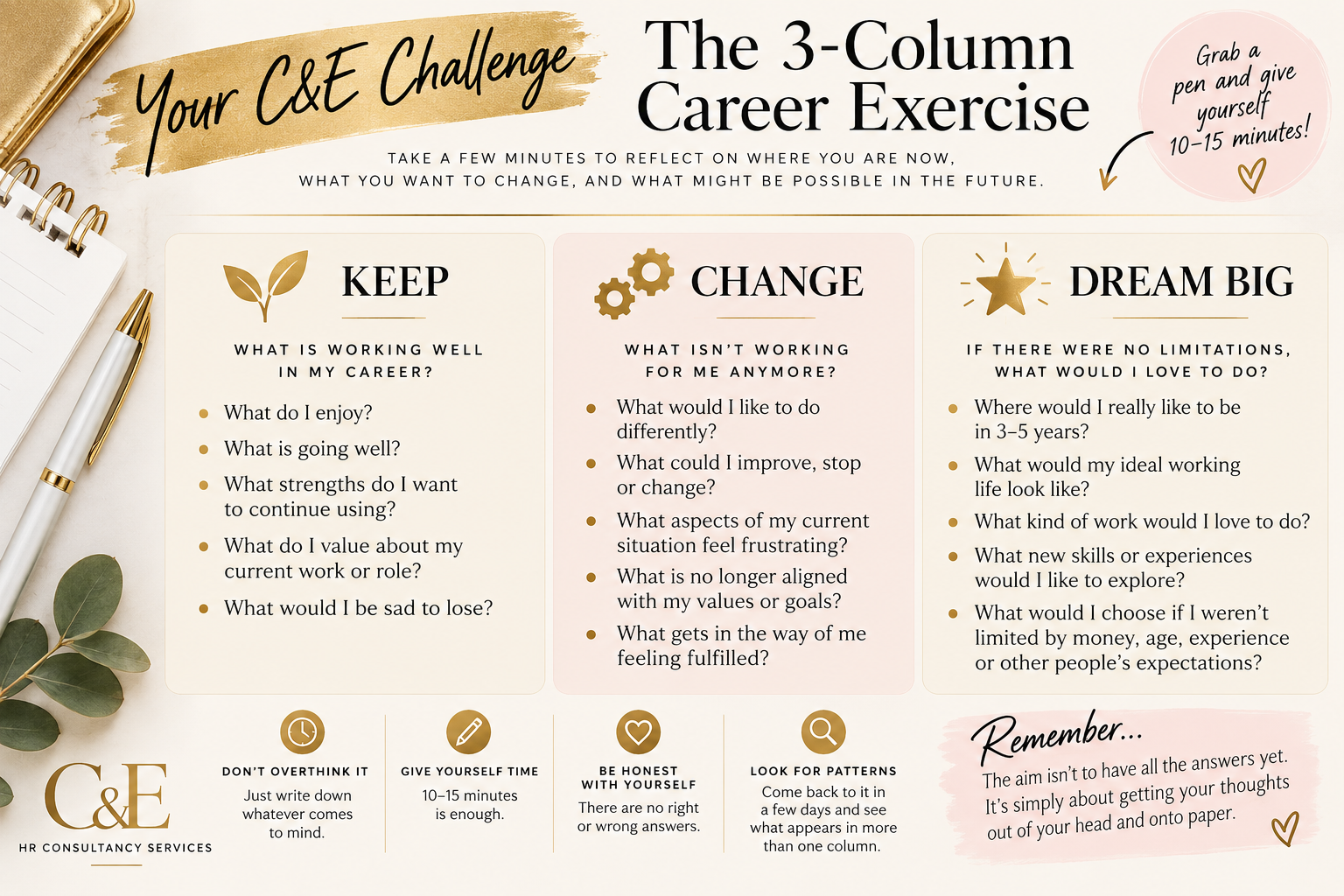
C & E HR Consultancy Services : Three-Column Career Change Exercise
Now look at the three columns together
This is where the exercise becomes interesting.
Perhaps your KEEP column says:
I love working with people.
I enjoy problem-solving.
I want flexibility.
Your CHANGE column says:
I'm bored.
I'm underpaid.
I have no progression.
And your DREAM BIG column says:
I'd love to work independently and help people develop.
Suddenly, you have something much more useful than "I think I need a new job." You have the beginnings of a career strategy.
You don't always need all the answers
One of the biggest mistakes people make is believing they need to know exactly what they want before they can take action. You don't.
Sometimes the first step is simply becoming clearer about:
What do I want more of?
What do I want less of?
What am I curious about?
Clarity doesn't always arrive before action. Sometimes clarity comes from exploring.
Don't underestimate what you already bring
This is particularly important if you're considering a career change later in your career.
You are not starting again. You're starting from experience.
The skills you've built over the years (communication, leadership, relationship-building, problem-solving, resilience, commercial awareness, managing difficult situations) don't disappear because you change direction. They may simply need to be repositioned.
That's why a good career strategy isn't just about finding your next job. It's about understanding your value, your options and where you want to take them next.
So... what would you put in your three columns?
Take 15 minutes this weekend and draw three columns:
KEEP | CHANGE | DREAM BIG
Don't overthink it. Write down whatever comes to mind.
Then leave it and come back to it, perhaps several times. Treat it as a work in progress: add to it, cross things out, move things between columns.
You might be surprised by what you discover. Sometimes you don't need someone to tell you what career to choose. You need the space, structure and questions that help you work it out for yourself.
What happens next?
Career Catalyst™ is my 12-week personalised career coaching programme, designed to help you move from career uncertainty to clarity, confidence and momentum.
Together, we look at where you are now, what's holding you back, what you're good at, where you want to go and, most importantly, how to build a realistic strategy to get there.
I'm currently welcoming a small number of people into my Founding Pilot at a special introductory price.
👉 If you're ready to stop going round in circles and start getting clear about what's next, I'd love to hear from you.
To find out more about Career Catalyst™, email Gillian at yourconsultant@candehrconsultancy.com